
What a River Cruise Can Teach Us About Retail Leadership
What a disrupted vacation taught me about retail leadership, customer experience, and leading through change
The best leadership lessons don’t always come from the boardroom. Sometimes they come from a river cruise that runs out of river.
When circumstances change unexpectedly, leaders can’t always control the problem, but they can control how they respond. They can communicate clearly, stay calm, adapt the plan, support their people, and protect the customer experience. I learned that firsthand this summer when my husband and I embarked on an eight-day European river cruise that turned into something very different from what we had planned.
Key Takeaways:
- Leaders can’t control every disruption, but they can control their response.
- Transparent, frequent communication builds trust when plans change.
- Great leaders focus teams on what they can do rather than what they can’t control.
- A leader’s emotional response is contagious. Teams take behavioral cues from the person leading them.
- Customer experience is about being intentional with how you respond when problems occur, because not every problem can be anticipated or preempted.
- Adaptability requires making decisions without having every answer.
- Leaders should protect their teams from unnecessary frustration while acknowledging reality honestly.
- The best leadership often becomes visible when the original plan no longer works.
My husband and I planned a wonderful river cruise this summer from Regensburg to Budapest, traveling through Germany, Austria, Slovakia, and Hungary. We were looking forward to unpacking once and enjoying the beautiful scenery and perhaps cooler temperatures as Europe floated by and we relaxed aboard the ship, unwinding from the stress of running a successful business.
Mother Nature had other plans.
What happens when your 8-day European river cruise runs out of river?
Extreme heat and prolonged dry conditions had lowered sections of the Danube River to the point that our itinerary couldn’t operate as planned. Instead of eight days of cruising, we experienced less than eight hours of it. Along the way, there were motor coaches, itinerary changes, three different ships, packing and unpacking, and temperatures reaching 103–104 degrees.
In other words, it was the exact opposite of the seamless, unplugged experience I had envisioned when I organized the trip earlier this year. But I learned some powerful lessons about leadership.
The cruise company, Scenic River Cruises, couldn’t control the river. But they could control their response.
Communication began a week before our embarkation date and continued throughout the trip. Scenic was transparent about the conditions and gave us options, including rescheduling or receiving a refund. We had been looking forward to the trip, and reworking our entire vacation at that point sounded like more work than going with the flow. After all, I’m from the world of retail — I’m used to change! So we forged ahead. And we were certainly immersed in change.
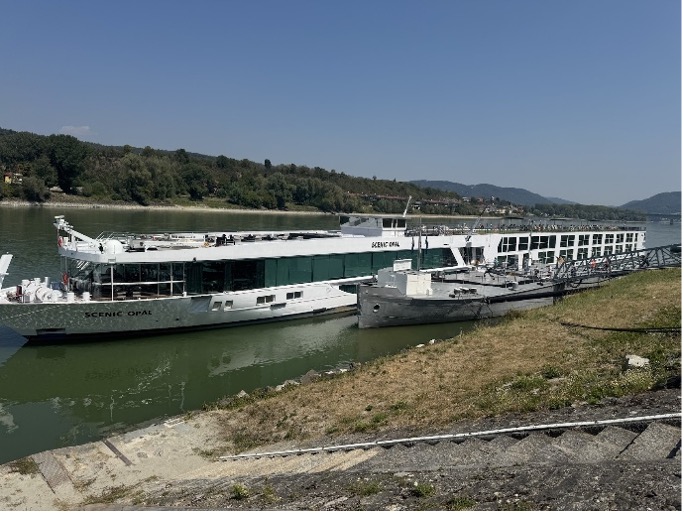
Our itinerary changed again before we even boarded. Stops changed. Ships changed. We spent three nights docked in Passau, Germany, where the Danube was so low that the view from the balcony of our beautiful junior suite was mostly rebar and graffiti below the dock!
Scenic adapted.
When the river couldn’t take us somewhere, coaches did. We explored beautiful cities, abbeys, castles, orchards, and palaces throughout Germany, Austria, and Slovakia. We eventually enjoyed a few precious hours actually cruising the Danube, before conditions required another change of plans.
Then we packed again.
And changed ships again.
Ultimately, the river levels became too low to safely complete the journey by water, so we arrived in Budapest by coach and spent the final night of our “river cruise” at a hotel.
Was it the vacation we planned? Absolutely not.
Was it an extraordinary lesson in service and leadership? Absolutely.
Two-thirds of the passengers had opted to take Scenic’s refund or credit offer and canceled or left after the first night. That left an adventurous group of just 68 passengers … and a crew of 58.
The captain, cruise director, restaurant and food & beverage directors, chefs, waiters, bartenders, housekeepers, engineers, butlers, sailors, and deckhands had to adapt constantly and even turn over ships multiple times during our journey. Just like us, this was not the journey they had signed up for. Yet you rarely saw a single member of the crew without a smile or a can-do response.
Cold towels and cool beverages were waiting whenever we returned from excursions in the oppressive heat. There were games, nightly entertainment, laundry service, wonderful meals, and seemingly anything we could want to eat or drink.
I have significant food allergies requiring a dairy- and gluten-free diet. Yet I was able to eat panna cotta, apple strudel, and even fish and chips, all delicious, all prepared gluten- and dairy-free. Every morning, the restaurant manager greeted me with the day’s menu. Their approach was never about telling me what I couldn’t have. Instead, it was, “What would you like, and how can we make it work for you?”
Our butler checked on us daily. Communication from the captain and leadership team was consistent, frequent, and honest, with just the right balance of humor and empathy.
For example, one night in Vienna, after having been docked for two days with only bus excursions, the captain could tell we were all getting “river-less fatigue.” Following dinner, he ushered everyone on to the top deck for drinks, champagne, and a nighttime mini-cruise around Vienna. We toured around the harbor and enjoyed the city lights and bridges, promising not to stand up or get too close to the edge, although with the water levels where they were, he knew we would all be safe.
Along the way, something else happened.
The passengers who stayed became friends. We all knew what we had signed up for. Every one of us had been given the option to leave, but we chose to stay and make the best of it. We met wonderful people from Europe, Canada, Australia, and the U.S., and instead of bonding over complaints, we bonded over the adventure.
It got me thinking:
We can plan and plan, but there are so many variables that remain out of our control.Leaders must navigate according to their best-laid plans, but great leadership is often revealed when absolutely nothing is going according to plan.
Retail leaders deal with plenty of things they can’t control. Someone calls out before a busy Saturday. A shipment arrives late. Technology goes down. Construction blocks the entrance. Weather keeps customers away or unexpectedly sends them flooding in. A promotion doesn’t perform as expected. A new initiative changes at the last minute.
Even in a state of flux, great leaders have enormous influence over how their teams experience those moments.
The Scenic crew didn’t spend their time reminding guests that the situation wasn’t their fault. They didn’t visibly complain about how difficult all the changes were for them—and believe me, they were. They didn’t allow their own frustration to become their guests’ problem.
They communicated, adapted, problem-solved, stayed positive, took care of people, and kept moving forward.
From a River Cruise to Retail: How Great Leaders Show Up in Rough Waters
When everything is running smoothly, lots of people can look like good leaders. But when the plan blows up, you discover:
- Who stays calm?
- Who communicates openly?
- Who focuses on what can be done?
- Who prevents their frustration from becoming the team’s frustration?
- Who makes decisions without having every answer?
- Who remembers that the customer is experiencing the disruption, too?
- Who models the attitude and behaviors they want their team to demonstrate?
If Scenic’s leaders had been visibly irritated—blaming Mother Nature, headquarters, port authorities, or one another—imagine how quickly that attitude would have traveled through the crew and ultimately shaped every passenger’s experience.
You can’t always deliver the experience you planned. But you can always influence the experience people have.
What Leaders Can Control When They Can’t Control the Circumstances
| Can’t Control | Can Control |
| Weather | Your response to it |
| Staffing call-outs | How you prioritize |
| Late shipments | How you communicate the impact |
| Technology failures | How quickly you pivot |
| Changing corporate priorities | How you translate change for your team |
| Customer frustration | How you respond to it |
| Unexpected disruptions | The team’s focus and next steps |
| The original plan | The quality of the new plan |
The leadership question evolves from “How do I prevent this from happening?” to “How do I lead my team through it?”
A store manager can’t control every variable affecting the customer experience. A district leader can’t prevent every disruption across their stores. But they have tremendous influence over how their people respond.
Scenic didn’t magically turn our disrupted river cruise into the vacation we originally purchased. Nor did they pretend there wasn’t a problem.
Great service isn’t pretending there isn’t a problem. It’s acknowledging reality and then doing everything within your control to make the experience as good as it can possibly be.
The next time something goes wrong—and in retail, we know something eventually will—remember that your team is watching more than the problem.
They’re watching you.
What Great Leaders Do When the Plan Falls Apart
1. Stay calm. Your team will look to you for behavioral cues.
2. Communicate honestly. Share what you know, what you don’t know, and what happens next.
3. Focus on what you can control. Don’t waste energy blaming circumstances that can’t be changed.
4. Adapt quickly. The original plan is no longer the plan. Create the best new plan available.
5. Protect the customer experience. Don’t allow internal frustration to become the customer’s problem.
6. Take care of your people. Teams need clarity, support, and confidence from their leaders during disruption.
7. Look for opportunities to create a better experience. You may not be able to deliver the experience you originally promised, but you can still create moments people remember.
What is leadership during disruption?
Leadership during disruption is the ability to remain calm, communicate transparently, make decisions with incomplete information, adapt plans, and help employees and customers navigate unexpected circumstances. Great leaders can’t necessarily eliminate every problem, but they are intentional about how they influence the way people experience and respond to the problem.
Your reaction gives others cues for theirs. Stay calm. Communicate. Focus on solutions. Take care of your people and give them the guidance and support they need to take great care of your customers and keep the business moving forward.
Sometimes our best leadership shows up when the river runs dry.
Leadership isn’t really tested when everything is smooth sailing. Great leaders face the storms and turbulence head on. In the process, they make a lasting impression on their teams and customers.
Even though our river cruise certainly wasn’t the vacation we expected, what I remember most isn’t the inconvenience or the ship changes or the hours spent traveling by coach instead of cruising the Danube.
I remember how the Scenic team responded. And I remember how they made us feel.
As Maya Angelou so memorably put it, “people will forget what you said, people will forget what you did, but people will never forget how you made them feel.”
When things go wrong, your customers, guests, and associates may eventually forget the problem. But they are far less likely to forget how their leader made them feel while navigating through it.
A coda to this story: When we arrived home, I saw that Scenic Cruise had deposited $2,000 in cash into my account, accompanied by a brief note: “Thanks for sticking with us last week! We hope to see you again soon.”
FAQ: Retail Leadership Lessons From Unexpected Disruption
What can retail leaders control during a crisis?
Leaders can’t control every external circumstance, but they can control their communication, priorities, decisions, attitude, and support for their people.
Why is communication important when plans change?
Frequent, transparent communication reduces uncertainty, builds trust, and helps employees understand what they should do next.
How does a leader’s attitude affect a team?
Employees take behavioral cues from leaders. A leader who remains calm and solution-focused can help prevent uncertainty and frustration from spreading through the team.
What does adaptability mean in retail leadership?
Adaptability means adjusting priorities, plans, and behaviors when circumstances change while keeping the most important customer and business outcomes in focus.
How can retail leaders improve customer experience during disruptions?
They can acknowledge the problem, communicate honestly, provide alternatives, empower employees to solve problems, and focus on what they can do to make the customer’s experience better.
What is the difference between good leadership and great leadership during disruption?
Good leaders manage the problem. Great leaders also manage the experience people have while the problem is being solved.