

Retail Burnout Warning Signs: Building a Sustainable Performance Culture
May is Mental Health Month in the United States, and it has me thinking about some of the unique stresses and demands that come with the territory if you’re in our industry. While all types of businesses are facing challenges in today’s environment, retail and service professionals in particular have spent years adapting to staffing shortages, operational pivots, heightened customer expectations, safety concerns, and economic uncertainty.
As a result, many retail leaders now operate in a constant state of “performance stress.” The question isn’t whether pressure exists. It clearly does. At the same time, though, we need our leaders and teams to be able to push themselves, try different things, and adapt to the continual cycles of change and disruption, all while stepping up to new responsibilities.
The bigger question is whether that kind of pressure is sustainable. Retailers need to be able to recognize the difference between complacency, productive stretch, and chronic strain.
Are Your Leaders Stagnating, Stretching, or Stressed Out?
We have used the Comfort Zone Model to depict this dilemma for years at MOHR Retail. There is a common fallacy that it’s a good thing to spend most of your time in your comfort zone. To be sure, it does feel good to be coasting along on autopilot with no friction and no big surprises. It’s certainly comfy. The problem is, you’re not growing and developing when you’re in your comfort zone. At best, you’re treading water. At worst—and it’s becoming more of a risk in an environment where things are moving faster than ever—you could be falling behind.
While the comfort zone may feel safe, staying there indefinitely can hamper your ability to be more agile and adaptable in the face of new challenges. The fact is, growth only happens outside of your comfort zone. Of course, by definition that means it’s going to be a little uncomfortable.
Think about what happened when you were learning to ride a bike and you took off the training wheels. There were a lot of wobbles, uncertainties, and probably a couple of bruised knees before you got that balance down right so you could ride in a straight line. Any kind of growth usually comes with a bit of pain and pressure. But journeying beyond the boundaries of what’s familiar will give you the confidence, mindset, and experience to better navigate the steep hills and winding roads ahead.
Balance is crucial: We’re not saying the comfort zone is the enemy. And this doesn’t mean you should always be pushing yourself or your team members to stay as far outside of it as possible. Instead, what we know is that remaining permanently inside your comfort zone limits growth, while remaining permanently too far outside of it creates burnout. The key is understanding how long and how far you stretch out of your comfort zone before you are depleted and suffer mental and physical fatigue.
The big takeaway? Short periods of stretch build confidence, agility, and capabilities. Continuous over stimulation without recovery erodes judgment, empathy, creativity, patience, and, eventually, your health.
A Closer Look at the Comfort Zone Model
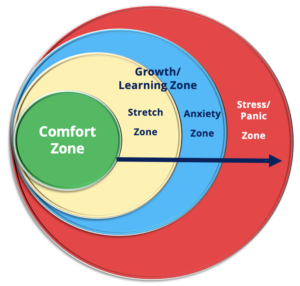
The Comfort Zone Model
Stage 1 – Comfort Zone: Necessary for recovery and consistency. Just don’t stay in it so long that it feeds complacency.
- Predictable
- Safe
- Efficient
- Low stress
- Minimal growth
Stages 2/3 – Stretch/Anxiety Zones: This is the growth and learning zone where leadership development happens.
- Healthy challenge
- Learning
- Stretch assignments
- Skill-building
- Increased confidence
Stage 4 – Stress/Panic Zone: This is where burnout begins. As many organizations confuse exhaustion with commitment, more retail leaders are no longer visiting the danger zone occasionally. They are living there.
- Constant urgency
- No recovery time
- Emotional exhaustion
- Cynicism
- Short tempers
- Disengagement
- Decision fatigue
Burnout Warning Signs Retail Leaders Often Ignore
Retail culture often rewards “pushing through,” which can mask burnout until it becomes severe. Here are some of the red flags that signal a leader may be headed toward burnout:
- Irritability
- Numbness
- Inability to “shut off”
- Reduced patience with teams
- Emotional detachment
- Loss of joy
- Performing but not connecting
Creating a Culture of Sustainable Performance
Sustainable performance requires sustainable people. Retail executives understand sustainability when it’s connected to retention, productivity, engagement, and customer experience. And that’s what being in the optimum growth and learning zone is all about.
Here’s what you’ll find among retailers that have successfully built a culture of sustainable performance:
- Psychological safety
- Realistic workloads
- Recovery time
- Recognition
- Permission to pause
- Coaching vs. constant correction
- Human-centered leadership
The goal is not to eliminate pressure. Retail and service organizations will always move fast and demand adaptability. The goal is to ensure people are stretched enough to grow, and supported enough to thrive.
To help them stay agile, adaptable, and energized, make sure your leaders have the tools and strategies to grow and develop beyond the boundaries of their comfort zones without crossing over into burnout. Learn more about retail leadership development opportunities here.